


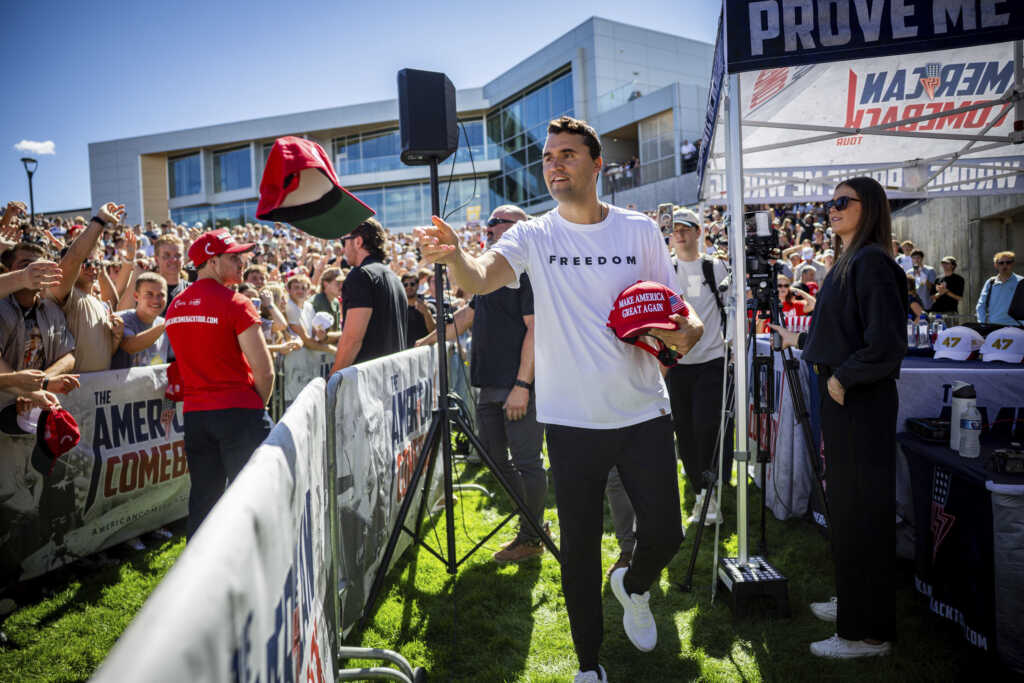
Following the horrific assassination of free speech activist Charlie Kirk in early September, more than 90% of American undergraduates believe that words can be violent.
The new data was compiled by the Foundation for Individual Rights and Expression (FIRE), which asked more than 2,000 college students about their perceptions of free speech in the United States.
Listen to the latest episode of “Quick Start” 👇
Surprisingly, the researchers found that 91% of respondents agreed to varying degrees that words are a form of violence, and only 9% believed that words were not violent. Kirk, 244 of the students studied at Utah Valley University in Orem, was shot and killed while peacefully and in good faith answering questions from attendees.
A small but worrying proportion of students (79%) said they agreed with varying degrees of “silence is violence.”
The foundation called the findings “particularly alarming in the wake of Charlie Kirk’s assassination, and an extreme and tragic example of the stark difference between words and violence.”
“Once people start thinking that words can be violent, violence becomes an acceptable response to words,” says Sean Stevens, principal research advisor at FIRE. “Even after the murder of Charlie Kirk at a lecture, college students believe that someone’s words can be a threat. This is the antithesis of a free and open society, where words are the best alternative to political violence.”
The study also found that American college students, particularly conservative college students, are increasingly concerned about sharing their opinions.
Several respondents said they felt uncomfortable expressing their opinions on controversial topics with other students in class (45%), in common areas (43%), and on social media (48%).
Nearly half of students surveyed said they felt more anxious about attending or hosting on-campus events, 35% said they felt more anxious about attending public events in general, and 21% admitted they no longer felt safe attending classes.
The report states, “Concerns are particularly pronounced among UVU students and among politically conservative students across the country. However, students who do not identify with Kirk’s politics also report refraining from public expression, suggesting that the effects of this political violence cross ideological lines.”
FIRE’s survey also revealed how deep the divide between conservatives and the left is.
“Moderate and conservative students were significantly less likely to say that yelling at speakers, blocking them from entering events, or using violence to stop speeches on campus is acceptable behavior,” the report said. “In contrast, liberal students’ support for these tactics remained stable or even increased slightly.”
According to the survey, 28% of students agree that using violence to prevent speech on campus is “always,” “sometimes,” or “rarely” acceptable, while 71% said violence is never acceptable.
Of those who said violence was acceptable, 26% said “throwing projectiles” was acceptable, 22% said the same was true for using “chemical irritants” such as bear spray, and 20% said “physical assault” on speakers was acceptable. Nearly half (46%) of respondents said none of these things were acceptable.
All of this happened after Kirk’s assassination and two assassination attempts on President Donald Trump. Still, 73% of students agreed with the statement that “political violence is a problem among conservatives,” and 42% said the statement “completely” or “mostly” explained their views.
A small majority (63%) agreed that “political violence is a problem among progressives.”
As the number of voices facing censorship from big tech companies continues to grow, sign up for FaithWire’s daily newsletter and download the CBN News app developed by our parent company to get the latest news from a distinctly Christian perspective.
