


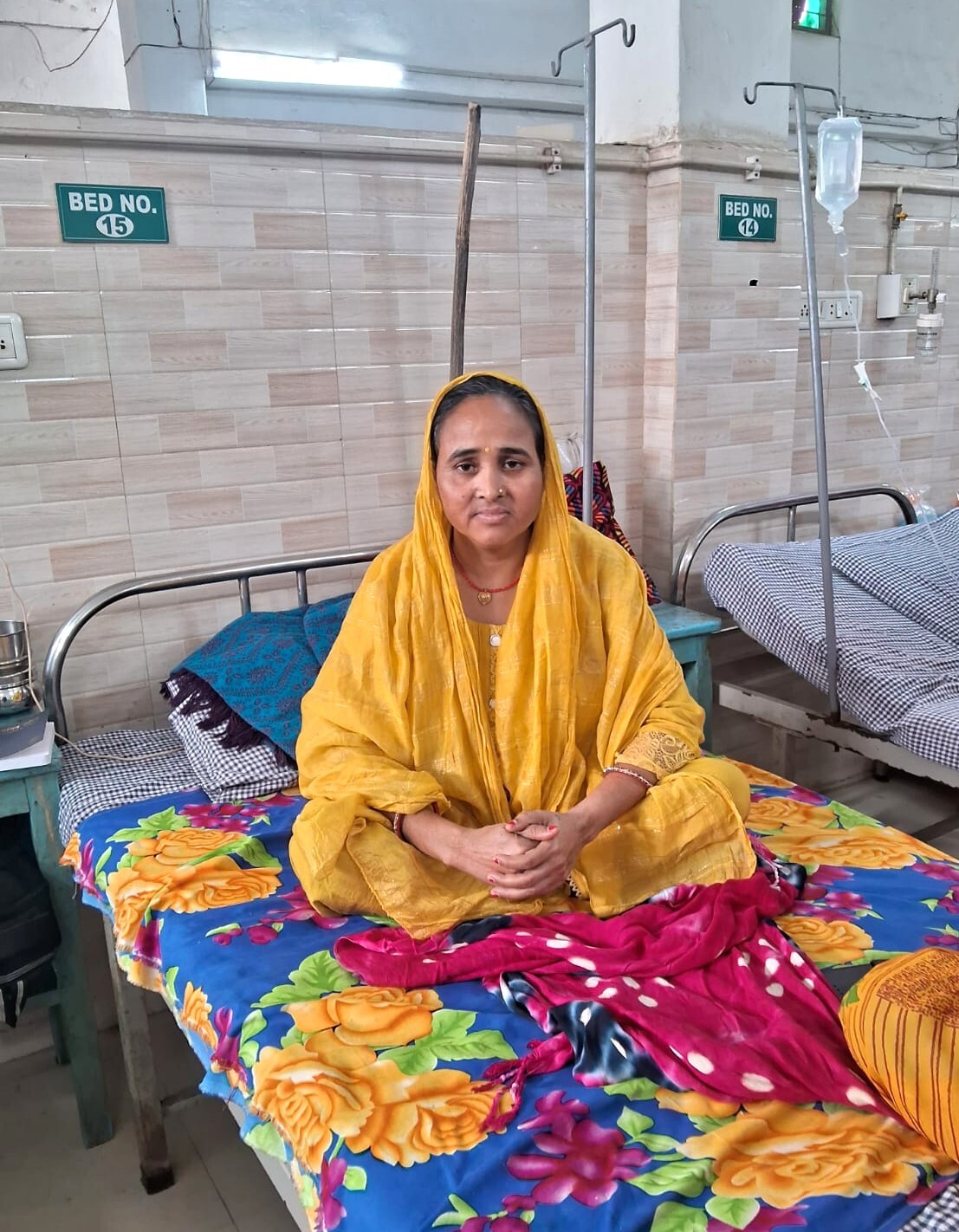
A Christian woman who was imprisoned in India for 86 days on false charges of fraudulent conversion was diagnosed with cancer in October, sources said.
Sheila Devi (45) from Dabei Ka Purva village in Uttar Pradesh was released on bail on October 14 and has been admitted to Kachwa Christian Hospital since October 20.
Evangelical Federation of India (EFI) staff said that after several tests, doctors confirmed uterine cancer on November 21 and she underwent a hysterectomy on Wednesday (November 26). The Evangelical Alliance of India (EFI), along with other partners, is bearing all of her personal and medical expenses after she is released on bail.
A mother of three adult sons and a daughter, she hosted social gatherings in her home for two years, attended by 30 to 35 people from her village and nearby areas. Brahmins in her village opposed this association and once reported her to the police, who issued her a warning.
Devi said the gathering could not be canceled because participants would be deprived of spiritual food.
“I said to the Lord, if I leave the fellowship of this church, these people are going to be scattered all over the place, they’re going to be more alone, they’re going to walk in sickness,” Devi told Morning Star News. “They find peace and healing when they come to church.”
Devi continued in communion, but during a Sunday service on July 20, a large police force entered her home, where the church was meeting. Devi said a female police officer led the way, followed by a male police officer. They questioned Devi about the reason for the rally and claimed that she was fraudulently converting people.
“They confiscated all the Bibles, crosses, songbooks, posters of the Ten Commandments on the walls and amplifiers,” said Devi, who is illiterate. “They took my cell phone, my only source of information, and listened to God’s word (through a Bible app).”
They placed her in a police vehicle and also detained seven men from the church. Six of the seven people, including 71-year-old Ram Chandra Verma, were visiting the church for the first time. Verma was nearly bedridden due to a prolonged illness and visited the church seeking prayers for healing. His wife, Rajpathi, is the only follower of Christ in the family and has been attending church for the past 18 months.
“My husband stepped into a church for the first time in his life,” she told Morning Star News. “He was picked up randomly among the faithful by the police.”
A case was registered against Devi, Ram Chandra Verma, Rajendra Verma, Ram Saroj, Ashok Saroj, Kartu Saroj, Mukesh Saroj, Sunil Saroj and unidentified persons on the ground of “common intention” under the Uttar Pradesh Anti-Conversion Act against Forced/Unauthorized Conversion and the Bharatiya Nyaya Samhita (BNS), 2023.
The two were produced before a magistrate at 4pm on the same day and sent to Pratapgarh Jail.
suffering in prison
Devi was sent to the women’s barracks, where 55 female prisoners were housed. She initially faced disrespect, abuse, and discrimination.
“The murderer was treated better than me. They called me a ‘proselyte’,” Devi said.
The prisoners appeared before the guards every Saturday, and the guards often tried to persuade Devi to return to her Hindu faith.
“Why do you believe in Jesus, who died on the cross? Why did you abandon your God?” Devi said the guard asked.
She observed that the female prisoners suffered greatly and cried day and night.
“All the women in prison wanted to see their families, especially their children, but those who were most affected were those who no longer had visitors,” Devi said. “They were forgotten by their families and felt like they had no place to belong anymore.”
Visiting family members in prison means a huge financial burden for relatives, who must give inmates 5,000 to 10,000 rupees ($60 to $120) each week to help them support themselves, she said.
“With this money, our members in prison will buy toiletries, food, fruit and snacks,” she said. “Prison food tastes bad and is of very low quality. What we were given was half-cooked rice, watery lentil soup, and half-burnt chapatti (Indian bread).”
Mrs. Devi said she was the only Christian in the prison. Sometimes she felt lonely and discouraged, but she spent a lot of time in prayer. A week later, four Christian women were arrested under similar anti-conversion laws and sent to jail in Kunda, Pratapgarh district, 50 kilometers (31 miles) from Pratapgarh city.
“At first, when I saw the women suffering in the prison, I was completely devastated. I was overwhelmed by their constant crying and despair, but then the Lord sent four believers to the prison,” Devi said. “I was so encouraged to meet them that we started praying together.”
She was able to survive because her son visited her regularly and gave her money.
“I am very grateful that my son comes to see me three times a week and gives me the money I need every week,” Devi said. Devi said that while the other four Christian prisoners had to work due to their lack of means, Devi paid him so he didn’t have to work. They were given “the dirtiest job of cleaning prison toilets because they were Christians,” she said.
Soon she began to fall ill, and her health deteriorated due to constant bleeding and lack of nutrition. Eventually, the time came when I could no longer move my arms or legs.
“I couldn’t move, I couldn’t stand, I couldn’t walk, I couldn’t talk,” she said. “The guards on duty instructed everyone, including the Christian woman, to stay away from me. They knew I was dying and were worried that I had a disease that could be transmitted to other prisoners.”
Devi lay on the mattress on the floor and prayed.
“I silently cried out to the Lord, ‘Please don’t let me die here. When it’s time to go, let me out of the prison. If I die inside the prison, your name will be tarnished. They’ve always seen me praying to you. If I die, they’ll despise your name,'” she said.
Devi said she could see “the light of the Lord” shining on her in her cell as she prayed. She felt stronger and was able to not only stand but also go out into the garden where other women were working.
“The women saw me and whispered to each other. We left her to die. She is a walking miracle. I told them that the Lord had healed me so I could speak, stand and walk,” she said.
Devi said she started waking up at 3 a.m. and spent an hour seeking the divine purpose that took her to prison and miraculously healed her. On August 24, after completing her daily prayers, Devi was again lying on the mattress on the floor when she suddenly felt a very bright light in the barracks.
“I wondered where the brightness was coming from, and when I opened my eyes, I saw Jesus standing at the gate,” Devi told Morning Star News. “I crawled on the floor and limped toward the Lord. The radiance of His light was so bright that I could not see His face. I spoke with Him for a very long time, and this was the first time I saw Him.”
From that day on, Devi’s situation changed.
victory
The next few months were the most memorable and precious, Devi said, adding: “I received more love inside the prison than outside.”
One of the Christian women got bail, and many inmates noticed. Some non-Christian women approached Devi and asked her to pray for them. After that, another Christian woman was saved, and more women became aware of it and started coming to pray.
The situation began to change rapidly, and the attitude of the guards and prisoners towards her completely changed.
“Many women were released on bail and many were healed. Women police officers on duty were also healed. They consulted me about their family problems and asked me to pray for them,” Devi said. “The inmates pushed my legs to help me rest, and the guards brought me home-cooked meals from home. They all loved me so much that I have never received so much love in my own home.”
After 16 months in prison, the prisoner had given up hope of being rescued. After Devi prayed for her, she began attending church services every day and was finally granted bail on October 13.
“She danced throughout the prison and shouted with joy, ‘Jesus Christ saved me,'” Devi said.
Most women in prison had never heard of Christ. When they heard about Jesus from Devi, they “experienced a lot of peace,” she said.
The day she received bail, she told the Lord that she was available and expressed her desire for the Lord to continue to use her to change the lives of her fellow prisoners.
“I told the Lord that my work here is not finished and asked him to extend my stay,” Devi said. After the court ordered her released on bail, her case papers were somehow misplaced and she arrived at the prison just 15 days later, giving her more time to serve.
Devi was still feeling a little unwell and life in prison was physically difficult, so EFI took her to the hospital for tests. Doctors confirmed the cancer on November 21st.
At the time of writing, Devi was still recovering in the hospital. She asked for prayers for herself and all women in prison and thanked the Lord for allowing her to share the saving power of Christ with prisoners.
“Suffering is included in the package if we want to follow the Lord,” Devi said. “So I am very grateful to God for the initial suffering I suffered in prison, the joy I experienced in the following two months, and now for the successful surgery.”
Since Prime Minister Narendra Modi came to power in May 2014, religious rights advocates say the Hindu nationalist Bharatiya Janata Party’s hostile attitude toward non-Hindus has fueled attacks on Christians by Hindu extremists across the country.
India was ranked 11th on Christian advocacy group Open Doors’ 2025 World Watch List as the country in which it is most difficult to become a Christian, up from 31st in 2013, before the Modi government took office.
