


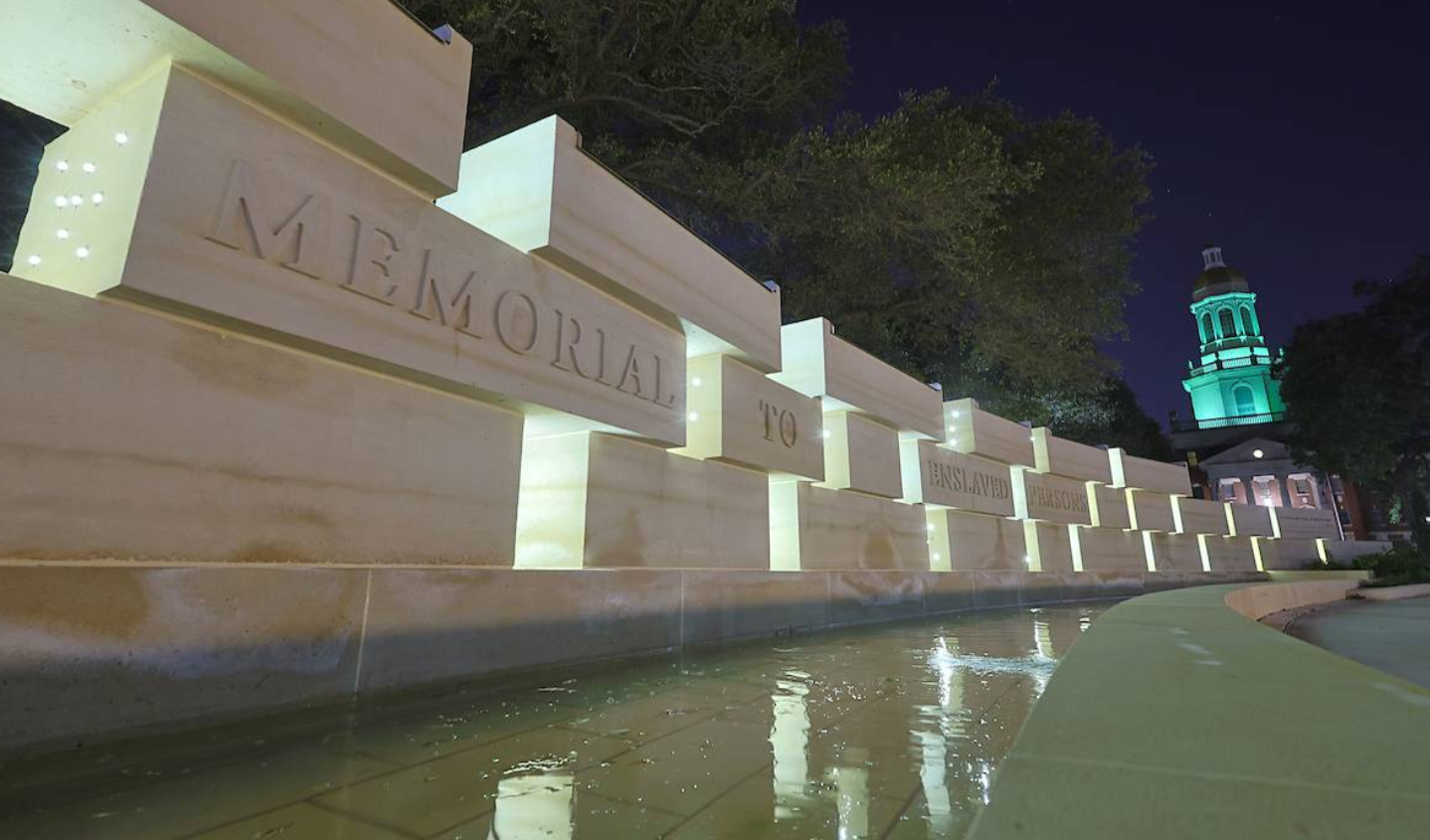
The legacy of the enslaved men, women, and children who built and sustained Baylor University’s early years was formally honored last week with the unveiling of a new Monument to the Enslaved on the Texas campus. The memorial is the first permanent campus structure dedicated to recognizing the role of slave labor in the university’s founding in 1845.
The memorial stems from recommendations issued in 2021 by Baylor’s Committee on Historic Campus Representation and approved by the Board of Trustees. After the design framework was completed in 2022 and construction began with a groundbreaking ceremony in February 2024, the university dedicated the completed structure in a ceremony attended by faculty, staff, and students on Nov. 7 on Founders Mall.
Dr. Michael McFarland, a Baylor University alumnus and well-known figure in the world of education, gave a memorial address, quoting Hebrews 12:1, saying, “We are surrounded by a great crowd of witnesses.”
“It is an honor to stand here today as we dedicate this monument, a sacred place that honors the courage, tenacity, and enduring legacy of the enslaved men and women who helped build Baylor University.
“Today, we pause to remember the invisible and nameless people who worked in the heat, carved stones, cleared the land, and carried the burdens of others. Their names may not be in the official records of Baylor University, but their fingerprints are forever etched in the stones and soil across this campus. Their spirits are woven into the very fabric of this great university.
“The Bible reminds us that we are surrounded by a great crowd of witnesses, men and women whose sacrifices and faith stand us today. These witnesses are not just figures from a distant past; they are builders, servants, and slaves, and their silent perseverance paved the way for the future we enjoy today.”
Architectural firm Sasaki worked with Waco’s K4 Construction to design, develop and construct the monument. The property is designed as a large limestone-based cascading water feature located on Founders Mall, with nearby Resonance Gardens. The Resonance Garden is an amphitheater-style space created near the landmark to allow for personal reflection on the legacy of slavery.
The 33 illuminated cavities that run through the stone represent the 33 people of all ages enslaved by the university’s co-founder, Judge REB Baylor, as recorded in the 1860 census.
An inlaid map in the inner ring of the ground depicts the enslaved population of central Texas during that historical period, including the grounds of Baylor University.
The monument is also inscribed with Bible verses and related texts calling for Christian repentance and reconciliation.
In his memorial speech, McFarland quoted an African proverb: “When you pray, move your feet.”
“Faith without action is incomplete,” he explained.
“The people we honor today lived that truth. They prayed with their hearts, but they moved with their hands. Their bodies were bound, but their spirits were steadfast. They were denied freedom, but they laid the foundations for it.”
McFarland shared personal memories of growing up in East Texas. His father used to say to him, “Son, we drink from wells that we did not dig, and we sit under shade trees that we did not plant.”
“When I was a kid, those words seemed simple. Now that I’m a man, I know they’re sacred,” McFarland said.
“He taught me gratitude and responsibility: gratitude to those who made my life possible and a responsibility to honor their sacrifices by leaving a better legacy for those who come after me.
“That is what this monument represents. It is more than stone and steel; it is a testament to truth, courage and reconciliation. This monument calls all of us to remember honestly, live humbly and lead bravely.”
The monument thus served as a reminder that the university’s story, like the broader story of the United States, “is both complex and redemptive,” McFarland continued.
“It reminds us that Baylor’s story is as complex and redemptive as the story of our great nation. Rather than turning away from painful truths, this story challenges us to courageously confront them, persevere in the pursuit of justice, and honor those who labored in obscurity by ensuring that their descendants and all of God’s children experience dignity and opportunity.”
McFarland said the monument not only commemorated the suffering of the slaves, but also affirmed their humanity. Similarly, the commemoration not only commemorated their achievements in building the university, but also honored them.
“This monument is a testament to what is possible when a community chooses honesty over consolation, reconciliation over denial, and truth over silence,” McFarland said.
“This moment reflects the best of Baylor: not with shame, but with purpose and joy as we look back on our past. Not to rewrite history, but to redeem it.”
“May this monument be a place of reflection and renewal, a place where all visitors are reminded that progress comes from persistence, that courage often comes from the unseen, and that the true measure of a community is how it honors those who have no voice.”
McFarland hopes everyone who visits this site remembers that courage is born in struggle, freedom is purchased with faith, and heritage is sustained with love.
“In dedicating this space, let us commit to being builders of a more just and caring tomorrow, living and leading so that future generations can sit in the shade of our own faithful labor,” he added.
