


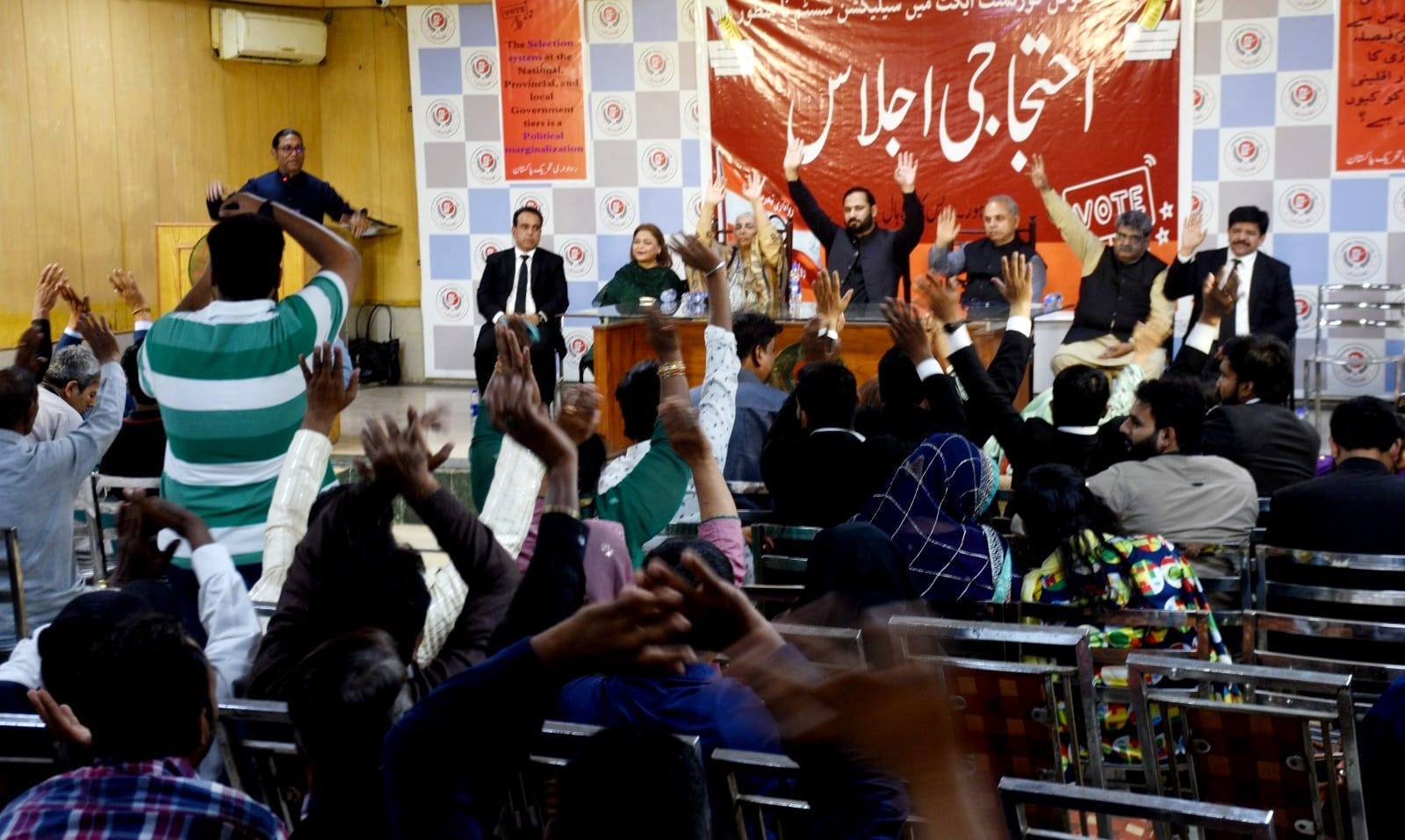
Christians in Pakistan’s most populous province of Punjab are protesting a new local government election law that denies religious minorities the right to directly choose their own representatives and undermines democratic participation through non-partisan elections.
The Punjab Local Government Act, 2025, which provides for the much-delayed local polls scheduled for late December, requires residents of more than 4,000 union councils covering rural and urban areas to directly elect nine ordinary members, but calls for four reserved seats for minorities, women, workers or farmers, and youth to be filled through a party-led “selection” process. Christians, who make up the majority of Punjab’s minority population, argue that the changes perpetuate the political marginalization of an already vulnerable group and violate constitutional guarantees of equality and local empowerment.
“Our biggest concern is the adoption of an undemocratic and unfair selection system for reserved seats. The right to elect one’s own representatives is the basis of meaningful participation,” said Samson Salamat, chairman of the Rwadari Tehreek (Equality Movement).
We are concerned that it will deepen the political marginalization of vulnerable groups in society, especially religious minorities, women and workers, he added.
Speaking at a People’s Assembly held at the Lahore Press Club on November 7 in collaboration with two other civil society organizations, Salamat said holding elections on a bipartisan basis would also undermine political representation.
“The Punjab Local Government Act, 2025 is against democratic principles and will lead to a lack of accountability and transparency. Without party affiliation, voters will not know what policies and principles local candidates support,” he said.
Catherine Sapna, executive director of paralegal organization Christians True Spirit, said Article 140A of Pakistan’s constitution guarantees administrative, financial and political powers to elected local government representatives. But she argued the new law undermines these protections and goes against core democratic values and constitutional guarantees.
“Since 2002, representation of religious minorities in the form of proportional representation in the national and provincial assemblies has already proven to be counterproductive for religious minorities. Instead of amending the law, the Punjab government has repeated injustices, depriving Christians and other minorities of the right to elect their own representatives even at the local government level,” she said.
He added that Rwadari Tereq, Christian True Spirit and Human Friends Organization jointly filed a constitutional petition in the Lahore High Court on November 5, asking the court to amend the law to allow religious minorities to directly elect their representatives.
Other speakers, including church leaders, lawyers, and social activists, also denounced the new law and called for direct elections to minority reserved seats. They said that for religious and social minorities to feel empowered at the grassroots level, local government polls must reflect justice, equality and true public participation.
The last local government elections in Punjab were in 2015.
The practice of filling designated seats through political party recommendations stems from the joint election model introduced by former military junta Pervez Musharraf in 2002. Under this system, minorities vote alongside Muslims to elect national and state representatives, while minority seats in parliament and state assemblies are distributed among political parties in proportion to their share of the vote, provided they secure at least 5% of the seats.
Ejaz Alam Augustine, a former Punjab Minister for Human Rights and Minority Affairs and currently a member of the provincial assembly, said repeated efforts to reform the electoral system for minority seats have not borne fruit.
“In order to effectively deal with the problems they face on a daily basis, power should be transferred to the grassroots level, especially for minority communities. However, successive governments have for many years avoided changing the law and deprived minorities of their right to elect their own representatives,” he told Christian Daily International.
Under Article 51(4) of the Constitution of Pakistan, 10 seats are reserved for non-Muslims in Pakistan’s 336-seat National Assembly. Under Article 106, the four provincial assemblies collectively reserve 24 seats for non-Muslims (out of a total of 749 seats). Additionally, four seats (one seat per province) are allocated to minorities in Pakistan’s Senate (96 seats).
Azam Mairaj, founder of minority rights group Tehreek-e-Sinaft (Movement for Identity), said the 34 seats in national and state parliaments meant little to minorities if they did not elect their own representatives.
He argued that the current electoral system creates a “fact” that is owed to mainstream parties, rather than to the minorities they are supposed to represent.
Mairaj advocated direct elections to designated seats, proposing a model in which all non-Muslims would retain the right to vote and compete for at-large seats at the national, state, and local levels, while electing their own representatives to designated minority positions.
“The basic mechanism of dual voting should allow non-Muslim citizens to directly elect their representatives to designated seats,” he explained. “Through constitutional amendments, minorities in each state should have representation at the federal level, with an increase in reserved seats consistent with the Constitution’s preamble, which calls for “adequate provisions” to protect the interests of minorities and disadvantaged groups.”
Mairaj added that constituencies for religious minorities can be delineated according to population size, and in areas where minority communities are small, smaller constituencies can be established to ensure fair representation.
