


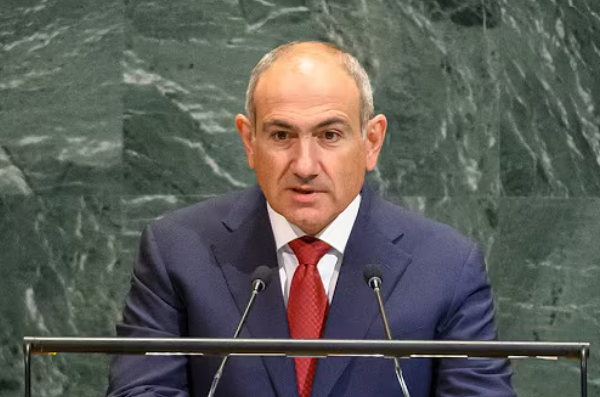
A bishop and 12 clergy of Armenia’s Apostolic Church have been arrested as part of a widening rift between church leaders and Prime Minister Nikol Pashinyan’s government. The arrest is the latest in a series of detentions targeting clerics critical of the regime.
Armenia’s Investigative Committee announced this week that Bishop Mukrtich Prosyan of the Aragatsson diocese was charged with coercing citizens to attend meetings, interfering with their right to vote, and abusing his office to commit grand theft, according to the Associated Press.
Authorities launched an investigation into Proshan in September after a fellow clergyman accused church officials of pressuring members to take part in anti-government protests in 2021, and following allegations of corruption in the Proshan diocese. Twelve other clergy from the same diocese were also detained, but their current status is unknown.
The Armenian Apostolic Church condemned the arrests, saying they were part of a “coordinated operation” to disrupt church operations. “There is a clear malicious intent to disrupt the normal activities of the church,” the group said in a social media post.
Leaders of the nearly 2,000-year-old Armenian Apostolic Church have largely opposed Mr. Pashinyan, a former journalist who came to power in 2018 amid a wave of pro-democracy protests. The prime minister has sought to reduce Russian influence and improve relations with Türkiye. Others credit him with helping open Armenia to Western influence.
However, the charges against Prussian follow a series of arrests of Apostolic Church officials and opposition leaders in recent months, including the high-profile sentencing of Archbishop Michael Agyapahyan in September.
He was found guilty of calling for the overthrow of the government and sentenced to two years in prison, the Associated Press previously reported.
Mr Ajapahyan’s lawyer, Ara Zohrabyan, was quoted as saying that his client was prosecuted for expressing his opinion and that the sentence was politically motivated. The church also condemned the ruling, calling it “a clear manifestation of the authorities’ anti-church campaign.”
The charges stem from an interview he gave more than a year ago, in which he reportedly said “there is a need for a coup,” according to Armenian news agency Civilnet.
The newspaper noted that at the time, the attorney general’s office reviewed the same statement and determined it did not merit prosecution.
Ajapahyan’s arrest came weeks after security forces tried to detain him at church headquarters, sparking clashes with clergy and supporters. He appeared before the Investigative Committee following a summons from the Armenian State Security Service and was taken into pretrial detention by a Yerevan court the next day.
Archbishop Bagrat Galstayan, a vocal critic of Pashinyan and leader of the opposition movement Holy Struggle, was arrested earlier this year on charges of plotting to overthrow the government. His defense team dismissed the allegations as fabricated.
Pashinyan has repeatedly accused the head of the Armenian Apostolic Church, Catholicos Karekin II, of violating his vow of celibacy and called for his resignation. Proshan is the nephew of Karekin II.
Church leaders, including members of the Holy Struggle, organized mass demonstrations in April 2024 after Armenia agreed to hand over several border villages to Azerbaijan as part of a plan to normalize relations. The movement initially focused on territorial concessions, but expanded to include broader dissatisfaction with Pashinyan’s rule.
Another outspoken critic of Pashinyan, Russian-Armenian billionaire Samber Karapetyan, was arrested in June on suspicion of calling for the government’s removal, a charge he denies.
On Thursday, Pashinyan received a visit from Archbishop Shahan Sarkissian on behalf of Catholicos Aram I of the Armenian Catholicosate of Cilicia, headquartered in Lebanon, in an apparent attempt to ease tensions between the Mother See of St. Echmiadzin of the Armenian Apostolic Church and Pashinyan’s government. According to a press release from Prime Minister Pashinyan’s office, the prime minister was presented with a book published to commemorate the 30th anniversary of King Aram I’s accession to the throne.
The deepening political rift comes as Armenia and Azerbaijan, the Muslim-majority countries led by President Ilham Aliyev, who has been in power for decades, continue to strive for reconciliation after decades of conflict. The two countries have been fighting over control of the Nagorno-Karabakh region since the early 1990s after the collapse of the Soviet Union.
At the heart of the dispute is the church’s opposition to Pashinyan’s territorial concessions to Azerbaijan, specifically the handing over of several villages on the Armenian border and the normalization of relations with Azerbaijan after the 2023 Nagorno-Karabakh offensive.
Many clerics, including those involved in the anti-jihad movement, have publicly resisted the extradition, viewing it as a betrayal of Armenia’s national and religious identity. The church was also critical of Pashinyan’s leadership and his attempts to consolidate power, especially through actions seen as undermining traditional institutions such as the Apostolic Church. Tensions escalated further after Pashinyan called for the resignation of Catholicos Karekin II.
Widely known as the first country to adopt Christianity as its state religion in 301 AD, Armenia is located at a strategic and often volatile crossroads between Europe and Asia.
On September 19, 2023, Azerbaijan launched a rapid military offensive to completely take control of Nagorno-Karabakh, calling it a “counterterrorism operation.” The attack followed a 10-month blockade that restricted access to food and medicine and led to the forced displacement of an estimated 120,000 ethnic Armenians in the region. Azerbaijan officially declared the dissolution of the Armenian enclave on January 1, effectively ending its autonomy and placing it fully under the authority of Baku.
Human rights groups accused Azerbaijan of carrying out the attacks to erase Armenian Christian cultural presence from the region. The European Center for Law and Justice documented the targeted destruction of churches, religious artifacts, and monuments and called the campaign a “cultural genocide.” The group warned of continued efforts to falsify historical records and remove Armenian heritage from the region, and called on international organizations to take action.
In August, the leaders of Armenia and Azerbaijan met at a White House summit, and their foreign ministers presented a draft peace treaty to end decades of hostilities, but it has not yet been ratified.
Originally published by Christian Post
